
What my conception journey taught me about dealing with my body and keeping hope alive.
My journey to conception was not an easy one. I was already 34 when my husband and I decided we were ready to start trying for children, and I was fully aware that I had a cyst on my left ovary.
Just the year before, at 33, I noticed that I was spotting outside of my cycle. The first gynecologist I consulted, an intelligent but aggressive sort, identified the ovarian cyst and informed me that its presence was likely to become a hurdle towards conceiving. The reason for the cyst? “Most likely, Endometriosis”.
What is Endometriosis?
Notorious for causing painful cycles, pelvic pain, bowel upset and even back pain, endometriosis is a condition in which tissue that is similar to the inner lining of the uterus grows outside of it1. It often affects the ovaries, fallopian tubes and the tissue lining the pelvis. There is a whole host of possible symptoms that come with endometriosis – none of them exciting.
Hearing this ‘likely’ diagnosis came as no surprise to me. I had had painful periods for years, and every gynecologist I had consulted in my 20s suggested that endometriosis might be the culprit. However, without going in surgically and seeing endometriotic cells with their very own eyes, gynecologists can never confirm this diagnosis. Even when a cyst is present, a gynecologist does not confirm endometriosis until after it has been removed and examined.
Earlier on in my 20s, more than one gynecologist had recommended I go on the pill to manage the period pain. How I wish I did! At the time, I was too conservative in my approach to medicine to ever give it a go, fearing mood swings and that common myth associated with oral contraception – loss of fertility.
At the time, I was too conservative in my approach to medicine to ever give it a go, fearing mood swings and that common myth associated with oral contraception – loss of fertility.
In hindsight, going on the pill may well have stabilized my hormones and prevented the formation of a cyst in the first place. But with no confirmation of endometriosis early on, this went unconsidered.
So, there I was at 33 – cyst and all.
About Endometriosis
To remove or not to remove, that is the question.
My gynecologist encouraged me to have the cyst removed within a few months, and to start trying for children immediately after – readiness and personal timeline be damned. What were the downsides of removal, I asked? One important drawback was the loss of ovarian cells. Since the cyst was on the ovary, some ovarian cells would have to be cut-out along with it. Depending on how much ovarian tissue was lost, this could in turn hamper fertility, making it harder for the ovary to produce eggs.
It seemed like both routes posed risks, and seeing as I was not in a hurry to conceive just then, I decided to delay.
A ‘Trying’ Time
By the time my husband and I were ready to start trying for children I was 34 and working with a different OBGYN in Hong Kong called Dr. Lucy Lord.
Thank the Lord! She was more conservative about surgery, and yet practical enough to lay out a plan for me based on biological factors: try naturally until I hit 35. Thereafter, look into cyst removal and, potentially, In Vitro Fertilization (IVF). Her rationale? Fertility rates tend to drop, and pregnancy risks tend to increase, after the age of 35.
Fertility rates tend to drop, and pregnancy risks tend to increase, after the age of 35.
In fact, pregnancies at age 35 or more are referred to as “advanced maternal age”, or “geriatric” pregnancies. Funny to think of it as geriatric when so many women of my generation choose to have children around this age, but there you have it!
Taking my age and medical history into account, making a beeline for IVF soon after turning 35 made sense. This was a plan I was comfortable with, and so we started trying.
Nine months ensued and, all the while, the cyst was becoming more and more of a bother. My monthly period, already the bane of my existence, got worse. I started having pain in the pelvic region even after my period was over, and essentially 50% of each month was spent on painkillers of some form. I was going for regular acupuncture visits to help me through it all, but that did not help sufficiently.
Having had that experience – seeing my life pretty-much unravel before my eyes because so much time was lost to pain – made me much more accepting of surgery.
Cyst removal surgery
Nine months, one HSG2 and one IUI 3 later, Dr. Lord recommended I have a cystectomy. To my surprise, she did not send me to an IVF specialist. Rather she sent me to a gynecological oncologist, Dr. TY Ng.
TY was wonderful: gentle, calm, precise. He ensured me that mine was a classic case of endometriosis, and together with Dr. Lord, recommended that we go back to trying naturally shortly after the cyst had been removed.
Around June 2020, I had a laparoscopic cystectomy. The overall experience was better than I expected. Recovery took 4 days in hospital, and about 2-3 weeks at home. I found myself wanting to walk around again just three days after coming home and I was able to resume normal activities after three weeks.
Trying fruitfully
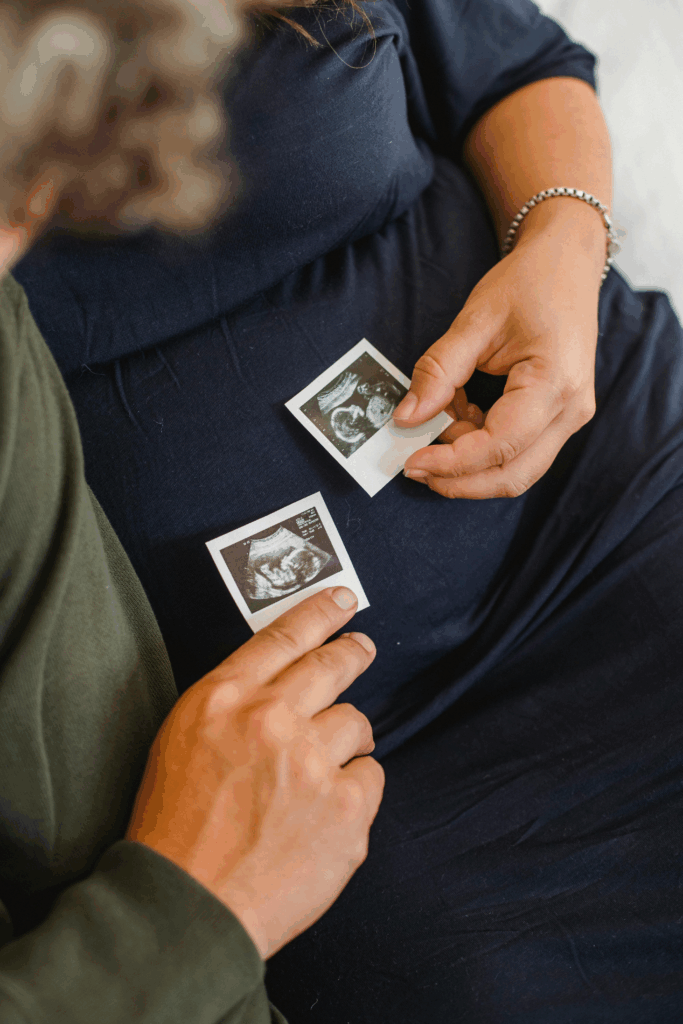
As per the doctors’ advice, we started trying again a few weeks later, and by August I was pregnant!
As per the doctors’ advice, we started trying again a few weeks later, and by August I was pregnant! There was certainly some disbelief, but if a positive pregnancy test was surprising, what came next was an even bigger shock.
There we were (my husband and I), back at Dr. Lord’s office for my 8-week scan. As Dr. Lord rolled the ultrasound over my belly, in her very British accent she said, “Oh! That’s interesting.”
Now, “interesting” isn’t necessarily a word would-be parents want to hear. It could be used as a euphemism for “concerning”, and we did not want reason to be ‘concerned’.
Thankfully, our fears were unfounded. Here is the conversation that ensued:
Me: “What’s interesting?”
Dr. Lord: “Well, look here. Here’s one heartbeat…and here’s another.”
Me: “Are you telling me we might be having twins?”
Dr. Lord: “No, darling. I’m telling you that you ARE having twins!”
Needless to say, our minds were blown. Not only were we pregnant, but we were also going to have two babies! At once!
We naturally asked the good doctor how this happened, considering twins didn’t particularly run in our families.
It seems the incidence of identical twins, as in our case, is a bit of a fluke. However, the occurrence of fraternal twins does increase in pregnancies of advanced maternal age, even without IVF 4.
Lessons learned
Trying to conceive can be a truly arduous time for a woman, calling into question why her body cannot simply perform as she would like it to. This was certainly part of my experience, and I know it has been part of the experience for many women who face difficulties either with conceiving or with maintaining a pregnancy. Ectopic pregnancies, missed carriages, early-terminations for medical reasons are all occurrences that can call into question one’s ‘ability’, and this can leave a women feeling depressed and alone.
In the time that I was struggling emotionally with questions about my condition, and fears that children may not happen for me, I found great solace in online forums. There was one specific to Hong Kong called Hope HK (on Facebook), where women in similar situations shared their own stories and bared their hearts. Reading it, I knew I was not alone.
As one would in any trying time, it is crucial to have a support system and to lean on it. This may take the form of family and friends, but connecting with others who are in a similar position can be especially powerful because what is shared will be relevant to your own experience. I recall spending time on Hope HK reading about everything, from what was involved in an HSG to the processes and costs of IVF. I also I knew that, should I wish to, I could reach out directly to people who had posted on the forum for more information, and that was empowering.
I would also say that it is also truly important to express one’s emotions rather than shelve those feelings. Seeking counselling or sharing with friends can be a powerful release. When I started speaking to friends about my conception struggles, so many of them opened-up with stories of their own. I’m grateful that we live in a time where there is far less shame around the topic of infertility, and that we can support one another in the journey.
In the years since my children were born, I have seen several friends who faced similar struggles successfully get pregnant, stay pregnant, and have healthy babies. Some did so naturally, and some through IVF. I have also seen friends who were not able to conceive find other solutions like surrogacy and adoption. I know a woman who, unmarried at 40, chose to conceive with the help of sperm-donors and IVF! And what I have realized through it all is that there is far more reason for hope than despair.
And what I have realized through it all is that there is far more reason for hope than despair.
If you’re curious about what twin-mama life looks like later on, I’ve written about my breastfeeding journey here: [Breastfeeding for a twin mama].
- World Health Organization (WHO). “Endometriosis.” World Health Organization, 24 Mar. 2023, www.who.int/news-room/fact-sheets/detail/endometriosis.
- Hysterosalpingogram: a diagnostic imaging modality utilized in assessing female infertility. By injecting a contrast dye into the uterus, the procedure enables visualization of the endometrial cavity and fallopian tubes to assess fallopian tube patency.
- Intrauterine insemination (IUI) is a fertility treatment that gives sperm a better chance at fertilizing an egg by placing prepared sperm directly in the uterus .
- NHS. “Pregnant with Twins.” Nhs.uk, 1 Dec. 2020, www.nhs.uk/pregnancy/finding-out/pregnant-with-twins/